
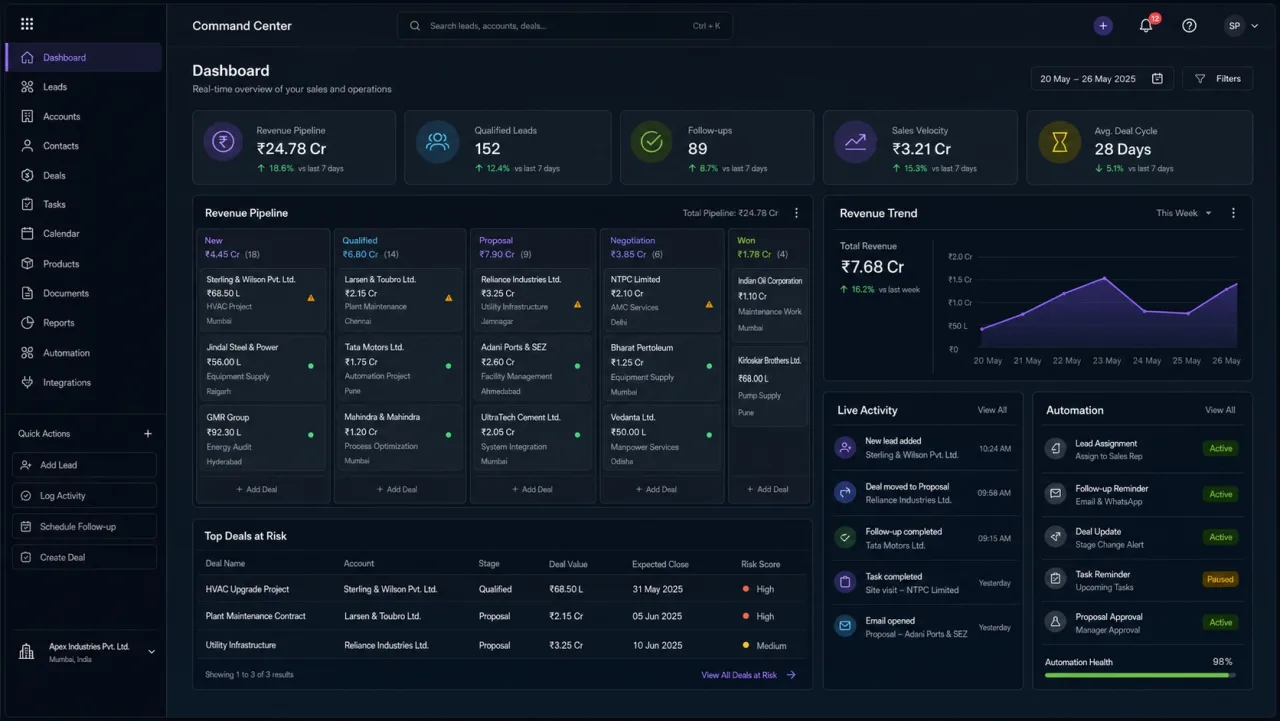
AI quality is constrained by workflow clarity, data quality and permissions. Fix the operating foundation before automating decisions at scale.
Put this guidance into practice
Explore our custom CRM and ERP development, software development, application launch, premium website development and business automation services. We scope the work around your existing tools, team and goals.
AI cannot repair an undefined process
Adding a chatbot or scoring model does not make a CRM intelligent. If lead stages mean different things to different users, ownership is unclear or outcomes are not recorded, the automation will amplify inconsistency.
An AI-ready CRM begins with explicit events: what happened, who owns the next action, what evidence is available and what outcome should be written back.
- Use controlled values for stages and outcomes
- Record timestamps and ownership changes
- Separate facts from generated recommendations
- Keep a trace of automated actions
Create a dependable customer data layer
Customer identity is often split across phone numbers, email addresses, invoices and support tickets. Before advanced automation, define how records are matched, updated and protected.
The system should expose clean entities for accounts, contacts, opportunities, activities, orders and service interactions. AI tools can then retrieve focused context instead of receiving an uncontrolled data dump.
- Define a source of truth for each field
- Prevent silent duplicates
- Track consent and communication preferences
- Apply role-based access to sensitive fields
Automate assistance before autonomy
Start with recommendations that a person can review: meeting summaries, suggested follow-ups, lead research briefs and exception alerts. This produces feedback and reveals edge cases without giving the model uncontrolled authority.
Move to automatic actions only where the decision is bounded, reversible and observable. High-impact pricing, credit, contractual or customer commitments should retain clear human approval.
- Draft before send
- Recommend before change
- Log inputs, outputs and approvals
- Measure errors as well as time saved
Design for measurable business outcomes
Define the operational result before choosing a model or vendor. Useful measures include response time, follow-up completion, qualified opportunity rate, data completeness and time spent on reporting.
DigiStartup India connects CRM architecture, integrations and automation into one phased system so AI is applied to a reliable operating process—not added as decoration.
Further reading
Frequently asked questions
What is an AI-ready CRM?+
It is a CRM with clean customer entities, consistent workflow events, permission controls, accessible context and audit trails that allow AI tools to assist users safely and measurably.
Can AI automatically follow up with CRM leads?+
Yes, but the system should define consent, timing, channel rules, escalation and human review. Begin with draft generation and bounded sequences before allowing autonomous communication.
Do we need to replace our existing CRM to use AI?+
Not always. Existing systems can often be improved through data cleanup, APIs, workflow automation and a controlled AI layer. Replacement is justified when the underlying data model or process cannot support the required outcome.